The short story:
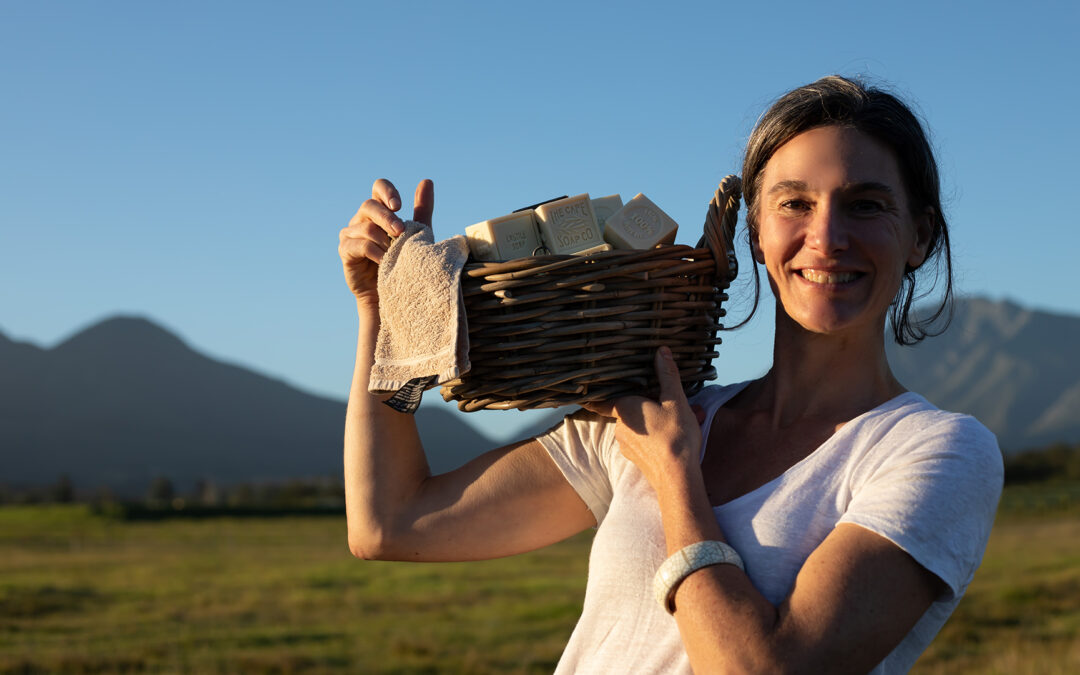
I am Caroline, founder of The Cape Soap Co.
I am a hiker. I love walking for days in nature, with everything I need in my backpack and around me: I am a tiny being on this Earth, yet I belong there. When I am home, I want to hold on to those feelings, to tread lightly and durably, harmoniously and joyfully.
I got interested in making skincare and home hygiene products a few years ago because I wanted to understand what I was putting on my skin and around my house and to limit the amount of single-use plastic in my recycling bin. Little did I realize, at the time, the rabbit hole I had entered!
I spent months exploring the world of natural products, zero-waste lifestyle, and much more. Finally, I came out of it with what became The Cape Soap Co.’s guiding principle: the drive to design a range as genuinely essential and kind to people and the planet as possible.
…
The long story:
Over the years, I have come to understand how my daily choices can have a cascading effect on the bigger picture. Amongst other things, I distinctly remember watching this 20 minutes video, The Story of Stuff, at a friend’s house one day. It hit a nerve. I became more thoughtful, considering the food I eat, the waste I generate, the products I use, the clothes I wear, the water and energy I need, how I move around… It was many years ago, and it was never a radical change. Rather it has been, and still is, a progressive, ever-revolving spiral of learning, observing, questioning, making choices, and going through the circle again…
I am aware that I am in a very privileged position to have the leisure to reflect so and to be able to make those choices. However, I am also aware that with great privilege comes great responsibility. And so, while other members of my family have been focusing on learning and practising water treatment, natural building, beekeeping, composting, permaculture, organic gardening, and agroforestry, I have been exploring baking, cooking, fermenting and preserving, and pondering the products my family uses daily on our bodies and inside our home, as well as what happens to the waste we generate. And it was quite organically that I became interested in soap-making.
It was love at first batch!
I started with a question:
How could I maintain good hygiene in my home, simply and with minimum impact on our planet?
At first, I could find an answer to these questions in the Savon de Marseille* of my childhood in France: the big natural soap cube sitting by the sinks in my grandmother’s house. Made with vegetal oils and caustic lye, biodegradable, versatile and zero-waste, it could replace most – if not all – the liquid products of dubious composition I had been getting in plastic containers. I am rather sentimental about it. I associate it with sweet memories of loving connections, preparing meals, washing dishes, or tending to the garden together: a cube of soap was always involved, before, during, or after.
So I searched high and low for anyone making Savon de Marseille in Cape Town. When I did not find a supplier, I decided to learn how to make it myself and enthusiastically started learning about soap-making.
My exploration started with the Savon of my childhood, but it led me to artisan Castile Soap.
When I discovered Castile Soap – in particular cold-processed Castile Soap bars – I fell in love:
I love how simple it is, made with olive oil and lye mixed at room temperature.
I love its many qualities and its understated elegance.
I love working with cold-pressed olive oil, its texture and its scent.
I love that cold-pressed olive oil’s health and skincare benefits are well-established.
I love that it is one of the few vegetal oils that are mechanically extracted without any heavy process.
And I love that this essential ingredient is produced near my home and workshop in Cape Town, where the Mediterranean climate has allowed for the fairly recent development of olive farming in South Africa.
Castile soap has become a passion!
I became an artisan soap maker and designed The Cape Soap Co. bars to resemble my childhood’s beautiful vegetal soap cubes. However, unlike the Savon de Marseille, my “Cape Soap” does not contain any oil other than locally-produced olive oil. Also, it is carefully handmade using very little water and energy, while the making of traditional Savon de Marseille involves boiling the soap paste for many hours and rinsing it with a lot of salt water.
– – –
The Cape Soap Co. range was designed after further exploration and further questions:
Our soap does a lot, but it doesn’t do it all.
What other products do I use when I clean my home and care for myself and for my family?
What is the impact of my choices?
Environmental: What do the ingredients and products do to my skin and my wastewater? Where do they come from? How are they made? What about their packaging and distribution?
And social and economical: Who makes my stuff? How? What value is created?
Could I use fewer, biodegradable, locally-made products and thus reduce the direct and indirect waste and carbon footprint involved, as well as my costs and clutter? And what would their simplest form be?
And can I choose to support local artisans and families in my communities?
And so I played with the idea of designing a range that would complement the ‘Cape Soap’ bar and be truly local, truly simple, truly essential, and as kind to people and to the planet as possible, with each item complementary to the others.
Although simple is not easy, and it took me some time to distil products and get to their essence, I am confident that, with The Cape Soap Co. I now have everything I need to maintain good hygiene in my home with minimal impact on our planet. Just like our soap, the few products in The Cape Soap Co.’s range are essential, multi-purpose, non-toxic, antiallergenic, high-quality, efficient, and economical. They also have a small carbon footprint and are made as simply (and beautifully) as possible.
Now, with The Cape Soap Co. I completed a challenge I had set for myself. And I am excited to share the result with you. But beyond this, I have learned much, and along the way, I discovered a mission which goes further than soap-making: I wish to model sustainable business design; inspire more connected choices for our daily routines; support and grow a community of like-minded artisans, entrepreneurs, users and producers; rejoice together in aligning values and actions; promote local resources; contribute to the conversation and work towards a more sustainable future.
It is a way of adding my voice to those of the activists who have inspired me to live a more reflective life and contribute to building a more harmonious, sustainable world.
We can clean our homes and care for ourselves without toxic chemicals.
We can minimise costs, waste, and environmental impact, through our choices (of ingredients, production, and packaging).
We can maintain good hygiene and a healthy glow while protecting our skin, wastewater, and environment.
We can do well with less (ingredients, products, bottles, industrial processes, imports/transports).
We can choose to support local artisans and families in our communities.
We can be kind to ourselves, each other, and our planet.
We can focus on the essentials, find beauty and joy in the simple things, and experience connections.
Prioritise quality, kindness, and proximity; buy less, remove clutter; value time; enjoy more!
*Savon de Marseille is zero-waste, natural, simple, multi-purpose, and antiallergenic.
It is a soap bar often sold nude (unpackaged).
It is made with natural ingredients: vegetal oils, and lye, and it is biodegradable.
It contains no animal fats, preservatives, colourants, or ingredients from the petrochemical industry.
It is an efficient cleanser, is antiseptic, and has been used for centuries to clean textiles and surfaces.
It is gentle enough for sensitive skin, face, and hair; and is often recommended by dermatologists.