Cold-process saponification is the process of making soap using natural oils, water and sodium hydroxide without applying an external heat source. We love that it is such an energy-efficient process.
When pure water and sodium hydroxide flakes are combined, they form an alkaline solution called lye. When oils or fats are combined with lye, a chemical reaction occurs, forming soap and glycerin. This process is called saponification.
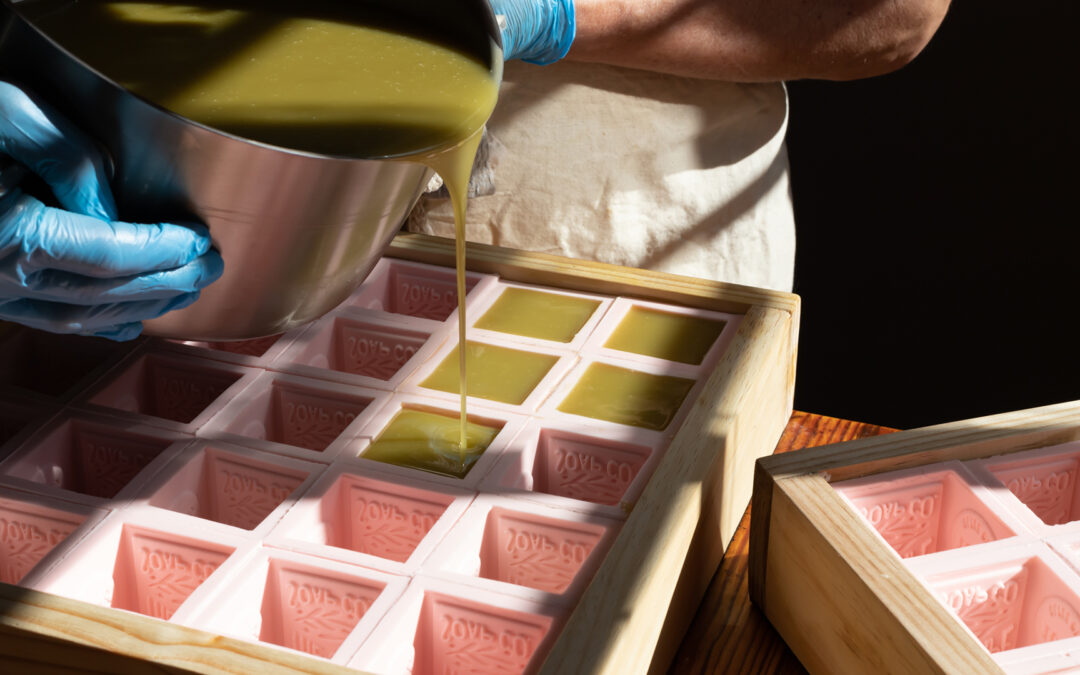
The cold process allows soap makers to create unique and customizable bars of soap. Unlike hot-process saponification, where heat is applied to speed up the process, cold-process saponification relies on time to complete the reaction. The soap mixture is liquid enough to be poured into customized moulds or to create colour effects if desired. It is then left to cure for several weeks, during which time it hardens and becomes mild and gentle for the skin.
More precisely, sodium hydroxide breaks down the oils into their component parts, fatty acids and glycerol. The fatty acids then react with the sodium hydroxide to form soap molecules and glycerin. The chemical reaction is exothermic, meaning it generates heat. This heat, combined with the oils’ insulating properties, allows the saponification process to continue without the need for external heat sources. As the soap mixture cools, it solidifies into a bar.
Thanks to its glycerin content, the resulting soap gently moisturises the skin. Indeed, glycerin is a humectant: it attracts and retains water, leaving the skin feeling and looking more hydrated.
This process also allows soap makers to control the amount of oil that is transformed into soap: they can ensure that a small percentage of the oil is not saponified and remains in the resulting soap bar as “superfat”. That oil is then available to condition the skin, filling and restoring the skin barrier.
Optional additives can be added to alter the soap’s texture, fragrance or colour. Examples of additives include essential oils, fragrance oils, herbs, clay and colourants. For natural soaps to remain truly biodegradable, care must be taken to avoid ingredients that can harm aquatic life when washed away.
No lye remains in the soap once the saponification process is completed. Lye is a caustic substance that can cause severe burns and must be handled carefully: wearing protective gear such as gloves and goggles when handling lye is essential. The amount of lye used in the soap-making process is critical. Too much lye can result in a harsh and drying soap, while too little can result in a soft and mushy soap. Soap makers use a process called saponification value to determine the correct amount of lye needed for their specific oils. The saponification value is a measure of how much lye is needed to saponify a particular oil or fat. Each fat and oil also has different properties that contribute to the final product’s texture, hardness and lather.
Although soap-making is an ancient craft, cold-process saponification is relatively recent. Indeed, it could only be developed when Sodium Hydroxide (also called Caustic Soda) became reliably available in the 19th century thanks to the development of industrial processes by chemists such as Nicolas Leblanc then Ernest Solvay, and today’s Chloralkali process. Sodium alkalis make hard soap without having to add common salt to effect the change.
Before this, soap makers could not measure precisely the alkaline content of their alkaline solution, whether sodium or potassium-based, and they had to rely on boiling oils or fats with an alkaline solution until – thanks to their skill, experience or luck – they could tell that the soap had formed and that the mixture was ready to be salted out, or “grained”, with brine (a solution of common salt and water), which would then make the hardened soap paste float to the surface leaving excess lye, glycerin and impurities to settle down. A process that is still used today by large scale soap producers, such as Savon de Marseille producers in Southern France for example.